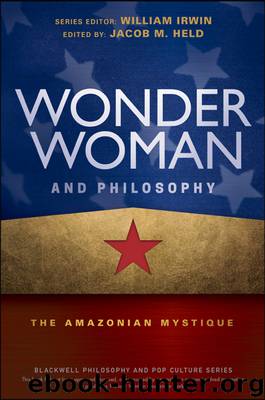
Wonder Woman and Philosophy by Jacob M. Held
Author:Jacob M. Held
Language: eng
Format: epub
ISBN: 9781119280743
Publisher: Wiley
Published: 2017-02-18T00:00:00+00:00
“When we don't want it, the truth burns.”25
Diana never wavers from her conviction that truth is an intrinsic good, that being truth-oriented is a moral duty, and that choosing to face the truth—even when it's difficult—is a virtue. In the opening pages of “A League of One,” she uses the lasso on herself as a test of her own integrity. “It is no small thing she does … being compelled to speak honestly might be uncomfortable—but facing one's true being is perilous.”26
One troubling case of Diana's use of the lasso involves sentient apes who have lived largely unaware that their culture and religion is not ancient, but recently fabricated from human mythologies. Specialist Lukk-Nutt asks Wonder Woman to bind her in the lasso so that she might “confess,” stating that she has been lying so long she can no longer trust herself to tell the truth. Lukk-Nutt sees Wonder Woman as “a pure thing. A golden mean, against which all of us must be measured.” (Both Aristotle and Confucius speak of virtue as a golden mean.) There is no ambiguity in Lukk-Nutt's case. However, the priestess of the apes, Abu-Gita, does not willingly consent to be bound. The Amazon tells her point-blank that “Your entire faith is based on a lie. A fallacy which it is high time you surrender.” The priestess is unable to cope with what is revealed, the “single bullet of truth” that destroys her sense of place and purpose.27 Lukk-Nutt wanted to face the truth; the priestess did not.
The most difficult moral questions arise in cases such as these, when Wonder Woman uses her lasso to compel someone to face a truth that he does not wish to face and the consequences of blissful ignorance are not clearly dangerous to others. As often stated, the truth can be hard; it can be uncomfortable; it can be painful. Truth can burn. It can cause emotional distress, cognitive dissonance, or prompt an existential crisis. Being encircled by the lasso of truth can be invasive, even when tempered by Wonder Woman's caring intentions. Perhaps the thing most at issue is whether or not the violation of individual autonomy can be justified by framing it as a sincere act of maternalism—doing what is best for a person, even when he does not know it or desire it. This is a difficult issue to resolve. A similar issue arises in healthcare ethics: is a physician morally justified in treating a patient who does not wish to be treated? Does a perceived mission to care for the physical or psychological wellbeing of an individual warrant violating her autonomy?
Perhaps the best foundation for an answer is found in Simone de Beauvoir's Ethics of Ambiguity, where she addresses situations such as intervening in a drug addict's self-destructive behavior, or preventing someone from committing suicide. An existentialist holds that freedom to choose is essential to our humanity, and the results of those choices are our fundamental self-creative act. So what Beauvoir proposes is that we
Download
This site does not store any files on its server. We only index and link to content provided by other sites. Please contact the content providers to delete copyright contents if any and email us, we'll remove relevant links or contents immediately.
| Anthropology | Archaeology |
| Philosophy | Politics & Government |
| Social Sciences | Sociology |
| Women's Studies |
The remains of the day by Kazuo Ishiguro(8999)
Tools of Titans by Timothy Ferriss(8394)
Giovanni's Room by James Baldwin(7346)
The Black Swan by Nassim Nicholas Taleb(7129)
Inner Engineering: A Yogi's Guide to Joy by Sadhguru(6794)
The Way of Zen by Alan W. Watts(6614)
The Power of Now: A Guide to Spiritual Enlightenment by Eckhart Tolle(5781)
Asking the Right Questions: A Guide to Critical Thinking by M. Neil Browne & Stuart M. Keeley(5775)
The Six Wives Of Henry VIII (WOMEN IN HISTORY) by Fraser Antonia(5515)
Astrophysics for People in a Hurry by Neil DeGrasse Tyson(5189)
Housekeeping by Marilynne Robinson(4447)
12 Rules for Life by Jordan B. Peterson(4304)
Ikigai by Héctor García & Francesc Miralles(4274)
Double Down (Diary of a Wimpy Kid Book 11) by Jeff Kinney(4271)
The Ethical Slut by Janet W. Hardy(4251)
Skin in the Game by Nassim Nicholas Taleb(4248)
The Art of Happiness by The Dalai Lama(4130)
Skin in the Game: Hidden Asymmetries in Daily Life by Nassim Nicholas Taleb(4006)
Walking by Henry David Thoreau(3962)
